
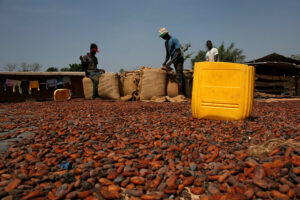
Africa remains largely a commodities exporter, despite the many ambitious plans launched — and, in some cases, realized — since independence. Countries that chose the Soviet path of development, such as Guinea, Ghana and Algeria, developed industries ranging from cotton processing to steel production, oil refining and food processing. But countries outside the Soviet bloc, including South Africa and Nigeria, also pursued industrialization. Admittedly, much of this industry was state-owned and fell by the wayside following the end of one-party rule or the liberalization of domestic markets under the structural adjustment programs largely introduced by the International Monetary Fund in the 1980s.
More industry, please
As the 21st century began, Africa was once again, in essence, an exporter of unprocessed commodities. The list is a familiar one: coffee, cocoa, cotton, tea and cashew nuts, as well as oil and gas, bauxite, iron ore, copper, platinum and, more recently, lithium. These resources are extracted from African soil or cultivated in its fields, then exported with little or no processing.
Finally, however, this is beginning to change, albeit slowly. Manufacturing currently accounts for an average of 10–11% of the continent’s GDP, and that figure must increase. Unemployment, particularly among young people, remains worryingly high, and manufacturing can generate employment on a scale that few other sectors can match, while also creating opportunities to add value to locally produced raw materials.
There is an urgent need to act, not only because of Africa’s persistently low contribution to global GDP, but also because prolonged youth unemployment is a ticking time bomb that governments must prevent from exploding.
There remains a gap in those areas of economic activity where value could — and should — be added. Increasingly, there is a realization that this must happen through initiatives undertaken at the domestic level, supported by foreign investment and expertise. The decision by the Dutch development bank FMO to provide a €20 million facility to Ivory Cocoa Products S.A., a leading cocoa processor in Côte d’Ivoire, is one example.
But developing this transformative economy requires policy. A telling parallel emerges from the African Development Bank’s 2025 industrialization assessment: Morocco, South Africa, Tunisia, Egypt and Mauritius feature among the continent’s leading industrial economies. These countries have also pursued industrial policies. This is no coincidence. Governance matters when a country seeks to transform its economy from one that exports commodities into one that produces and sells higher-value goods.
What needs to be in place
The African Development Bank identifies several conditions that must be met for a national economy to transform itself. Some lie largely beyond the control of those in government, most notably a country’s geographical location and the natural resources within its borders.
Chad, Lesotho, Burundi, Niger and South Sudan, for example, are disadvantaged by their lack of direct access to the sea, a constraint that is unlikely to change. Others, such as South Africa, Guinea, Morocco, Nigeria and Cameroon, have access to the sea and possess ports, as well as abundant supplies of one or more resources in global demand.
But other fundamental conditions must be met for an economy to evolve from exporting commodities to processing them and producing higher-value goods. These are conditions that governments can influence to varying degrees. They include political stability, a strong and transparent financial system, a skilled workforce and functioning infrastructure — roads and bridges, reliable electricity, telecommunications and internet access.
The list of countries moving up the industrialisation ladder suggests that those making progress have invested in two or more of these areas, helping to create a business environment that attracts investors willing to support the development of value-adding industries.
Senegal, Côte d’Ivoire, Eswatini, Namibia and Kenya feature among a promising group of African economies seeking to get this mix right. Others include Gabon, Nigeria, Botswana, Ghana, Angola, Rwanda and Mauritius.
Some countries, meanwhile, have lost ground, either because they have descended into conflict, as in Ethiopia and Libya, or because prolonged political uncertainty has made investors reluctant to commit themselves too deeply. In such environments, conditions can change suddenly. The Democratic Republic of the Congo, Equatorial Guinea, Cameroon, the Republic of the Congo and Zimbabwe illustrate different aspects of these challenges.
Governance
The key to meeting these conditions appears to lie in one place: governance.
Good governance prioritizes political stability and seeks to preserve it. It also aims to establish a functioning, transparent financial system, build sound infrastructure and educate and train people to become a skilled and dependable workforce.
Broadly speaking, countries that have established these foundations, or are making credible progress towards them, also feature among the leading recipients of foreign direct investment (FDI). Such investment is one of the important drivers of economic transformation, alongside private and public domestic investment.
It is therefore unsurprising that Egypt, Nigeria, Morocco, Kenya and Côte d’Ivoire feature among the leading African recipients of FDI in the 2025 rankings cited by Business Insider Africa.
Ethiopia’s inclusion is more complicated. Its position may partly reflect investments initiated before the country’s renewed conflicts disrupted its industrialization trajectory. Mozambique, also on the list, presents a different case: the conflict has been concentrated largely in the north, while some major investments are taking place offshore.
Mozambique and Guinea illustrate how seemingly contradictory conditions can coexist: abundant natural resources, authoritarian governance, an historically under-educated workforce, infrastructure that is only gradually developing, and relatively small financial systems whose capacity to support large-scale industrialisation remains limited.
These contrasting circumstances underline the need for precise, targeted business intelligence in every investment decision.
Due diligence
As more African governments seek to transform their economies from commodity exporters into producers of semi-finished and finished goods, opportunities are emerging for businesses willing and able to operate in these markets.
This brief overview illustrates why there is no one-size-fits-all model for assessing an investment destination’s capacity to absorb capital and put it to productive use. That capacity depends on a wide range of factors, all of which are subject to change. After all, what this article offers is a snapshot of an ever-evolving picture.
As a general rule, however, investors should look for countries that are relatively well governed and have industrial policies capable of encouraging prospective partners and investors to make a lasting commitment to economic development.
Africa Investigates offers the tools to help investors make those decisions on the basis of sound, evidence-based assessments.