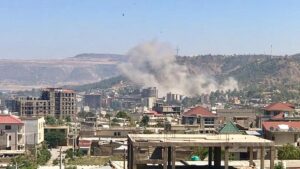
On 31 January, two separate drone strikes hit Enticho and Gendebta (Tigray Regional State), killing one person and injuring another.
- The Tigray People’s Liberation Front (TPLF), which engaged in a two-year conflict with the federal government in 2020, will push back heavily against the efforts of the ruling Prosperity Party (PP) to co-opt Tigrayan political leaders ahead of the 1 June elections.
- This will reignite historical territorial disputes between Tigray and neighbouring Regional States, especially Amhara, over the coming months.
- The renewed tensions between Ethiopia and Eritrea, which have stepped up engagements with some TPLF factions in recent months, will further complicate the matter.
- However, the shared reluctance of the TPLF and the Ethiopian federal government to re-engage in widespread conflict will mitigate another war in Tigray, at least over the next year.
- In the meantime, periodic clashes in Tigray and mounting ethnic violence in Benishangul-Gumuz and Oromia Regional States will pose periods of disruption for firms and humanitarian operators.
Fears of renewed conflict
A Tigrayan official told Reuters that the strikes were conducted by the Ethiopian National Defence Force (ENDF), the federal army. Sections of the local media claim that the drones hit two trucks carrying food, while pro-government activists insist that the trucks contained weapons. In any case, this comes amid mounting tensions between the federal government, led by the PP, and sections of the TPLF, a Tigrayan armed opposition group. The two camps engaged in an intense war between 2020 and 2022 over the control of Tigray. This resulted in the killing of over 600,000 civilians.
The TPLF and the federal government signed a peace deal in November 2022. Pursuant to this deal, Tigray is governed by a transitional administration (Tigray Interim Administration, TIA), whose leaders are appointed by Prime Minister Abiy Ahmed. Since then, widespread fighting has ceased, but sporadic clashes have been increasingly reported in recent months. Most notably, the ENDF engaged in a fight with a faction of the TPLF on 29 January in Tselemti, which is subject to a territorial dispute between Tigray and neighbouring Amhara. On the same day, Ethiopian Airlines, the National Carrier, suspended flights to Tigray. The flights resumed on 3 February, but fears of a renewed conflict between the TPLF and the ENDF have intensified domestically and internationally.
Elections
Although the security situation in Tigray will remain volatile over the coming months, we do not expect this to escalate into a widespread conflict, at least in the next year. Tensions between the TPLF and the federal government, resulting from the PP’s growing dominance and its success in co-opting TPLF leaders, will intensify as the 1 June elections approach. On 16 May 2025, the National Electoral Board of Ethiopia (NEBE) deregistered the TPLF, claiming that the party had failed to undergo a “special registration” process that would allow it to conduct political activities following the war. The TPLF, which maintains that its legal status is protected by the Pretoria agreement, sees this as an attempt by the PP to sideline the group and groom moderate figures ahead of the election.
The TPLF, which retains pockets of militias across Tigray, will be increasingly keen to demonstrate its ability to destabilise the TID and the federal government, to push for a reversal of the NEBE position. For its part, the federal government, which is keen to formalise the exclusion of hardline sections of the TPLF through a tightly controlled election, will resist these pressures. Instead, the federal government will support splinter TPLF parties, including the Simret party, to downplay any accusations of repression. The PP, which embarked on a campaign to centralise political power nationally in 2020, will seek to absorb these splinter movements after the elections, to further weaken the TPLF’s legitimacy and consolidate power over Tigray.
Eritrean influence
These dynamics are likely to revive contentious issues between the TPLF and the federal government, including some of the main drivers of the 2020-2022 Tigray war. For instance, many Tigray leaders are displeased with the continued presence of militias and regional forces from Amhara in Tigray, which has strengthened Amhara’s claims over the disputed territories. Moreover, the worsening tensions between Ethiopia and neighbouring Eritrea will facilitate sporadic collaboration between the TPLF and the latter country. Eritrea and Ethiopia fought on the same side during the Tigray war, but Eritrea was excluded from the Pretoria agreement. More importantly, Ethiopia has in the last year become more forceful about its desire to obtain sea access through Eritrea’s port of Assab. This will revive the historical mistrust between Eritrea and Ethiopia, encouraging the former to use proxy militias to destabilise Ethiopia. In addition to the TPLF, Eritrea will be increasingly open to collaboration with anti-government militias in Oromia, worsening tensions there too.
In this context, fighting pitting the ENDF and its allied militias against TPLF militias will increasingly occur, especially in Northern, Western, and South-eastern Tigray. However, clashes will be sporadic, as regional and international partners move to mediate between the two camps. Moreover, the federal government is keen to restore investor confidence, which dipped during the war, and will avoid widespread hostilities that could undermine economic recovery efforts. Likewise, the TPLF, which has been seriously weakened since the war, lacks the capacity to engage in another protracted war. Amid international pressure, the federal government may allow the TPLF to run for the polls, but this will be subject to heavy repression. Firms and humanitarian groups should anticipate brief but frequent periods of logistical challenges in Tigray, as fighting causes temporary disruptions to travel and transport.
Oromia and Benishangul
Meanwhile, the PP will be keen to restrict the participation of opposition movements in the poll. This, coupled with genuine logistical challenges – including inadequate infrastructure and insecurity – will complicate the June elections. Given that most opposition parties are organised around ethnic affiliation, election-related tensions risk worsening social cohesion. In Oromia and Benishangul-Gumuz, where weapons are easily available, this is likely to cause a spike in communal violence. Occasionally, these will target operators, especially in Oromia, where ethnic militias have increasingly demonstrated hostility towards foreign actors in the mining sector.
Sources
Drone strikes in Ethiopia’s Tigray kill one amid fears of renewed conflict, Al Jazeera.
Ethiopian Airlines restarts flights to Tigray region, official says, Reuters.
Port Assab becomes flashpoint for Ethiopia–Eritrea relations, DW.
For tailored analysis on the prospects of political stability in Ethiopia, please contact Africa Investigates Incorporated.
Email: africainvestigates2020@gmail.com
Tel: +221785282247