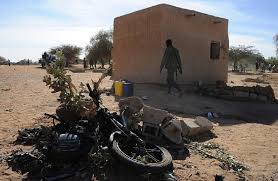
 On 28 April, Russian private military company Africorps announced that it had withdrawn from the Malian town of Kidal after two days of intense fighting with Tuareg rebels.
- Following a series of coordinated armed attacks in several parts of Mali, including the capital Bamako and the military town of Kati, on 24 April, the security situation in the country remains volatile.
- In our view, an attempt to forcibly remove President Assimi Goïta is increasingly likely in the coming months, further hampering the military’s ability to respond to the threat of militancy adequately.
- The government will face heavy domestic pressure to reconsider its hostile stance towards regional partners and the West, as the opportunistic nature of Goïta’s security arrangements with Russia becomes more apparent.
- This may eventually help Mali receive sustained security support from regional partners, but negotiations will be slow.
- In the meantime, further attacks in Bamako and its surroundings are likely, and rebels/Islamists could capture more towns, especially in Northern Mali.
- We advise operators to prepare for a worst-case scenario that would be characterised by regular army infighting, counter-coups, and a slow fragmentation of the country.
Coordinated attacks
Africorps claims that the withdrawal was a joint decision with the Malian government. The Azawad Liberation Front (FLA), a coalition of Tuareg-dominated rebel groups, had announced on 24 April that it had captured Kidal. On the same day, Islamist militant group Nusrat al-Islam (JNIM) claimed responsibility for a series of armed attacks in Bamako, Kati, Mopti, Gao, and Sévaré. Malian Defence Minister Sadio Camara and at least three of his relatives were killed during an attack on a residential compound in Kati. According to sections of the media, Goïta’s residence in Kati was also attacked. The attacks prompted violent clashes between the militants and the Malian army in Bamako and Kati, killing an unspecified number of civilians.
Goïta took power after a coup d’état in 2021. He has overseen a military rapprochement with Russia since then, especially following the withdrawal of French troops from the country in 2022. With the backing of Russian mercenaries, the Malian government regained control of Kidal in 2023, ending decades of Tuareg rebel occupation. Following this, Goïta’s junta in January 2024 terminated a 2015 peace agreement between the government and the rebels. In his first public appearance since the attacks, Goïta met with Russian Ambassador to Mali Igor Gromyko on 28 April.
Increased threat of coup
The ongoing security crisis is likely to trigger an attempted coup d’état over the coming weeks/months. The failure of the Malian army and their Russian allies to repel attacks on strategic areas in Bamako and Kati reveals deep capacity and institutional constraints that the regime has been grappling with since the coup. Goïta and his allies have worked tirelessly to conceal these issues, using a strong anti-Western rhetoric and repression of dissent. In the coming weeks, civil society groups, which have remained resilient in the face of repression, are likely to increasingly question Goïta’s socio-economic and security track record and push for reforms. This is likely to embolden dissidents in the army to also question Goïta’s authority and legitimacy. Mali’s history of repeated coups has legitimised unconstitutional changes of government, especially because most state institutions are weak and dysfunctional. The military, which is relatively more organised – despite deep fragmentation – will capitalise on this, with Goïta’s detractors seeking to replace him.
However, the success of any coup attempt will heavily depend on how much Goïta can retain the support of his domestic allies. The growing attacks on key supply chain routes, as underlined by the recent fuel blockage, and now the attacks on highly militarised areas in Bamako and its surroundings, show a growing desire by JNIM to disrupt the regime’s funding and structures. To prevent this and ensure the survival of the military-controlled patronage system, sections of the military will be increasingly open to a change of leadership. This faction would also be more likely to support a coup against Goïta in the event that civil society successfully mobilises mass protests over the coming weeks. This would increase the chances of a successful coup against Goïta.
Deepening of crisis amid complex geopolitical context
In any case, infighting and power wrangles in the military will make it even harder for the government to respond to the ongoing crisis. Further attacks in Bamako, Kati, Kayes, and Mopti are likely in the coming weeks. Moreover, the capture of Kidal by the FLA is likely to embolden other militants in Northern Mali, where the reach of the state is already limited, to scale up operations. The capture of more cities in Northern Mali by rebels or Islamists cannot be ruled out. For example, Reuters reported on 28 April that fighters of the Islamic State in the Sahel Province (ISSP) had established roadblocks in Ménaka.
In this context, the government, whether led by a weakened Goïta or another coup leader, will come under heavy domestic pressure to re-engage with regional partners and the West (US). The sustainability of the current arrangement with Russian mercenaries will come under mounting question, even as Goïta retains his strong support for Russia in rhetoric. To prevent a fragmentation of the country, the government will have little choice but to seek security support from regional partners and the US. Many of these partners will insist on democratic reforms, especially a return to civilian rule, complicating negotiations.
However, in our view, most regional partners, especially in the African Union, are likely to be in favour of a coordinated regional response to the ongoing crisis, amid fears that further advances by the Islamists could embolden JNIM and ISSP to scale up attacks in neighbouring countries, notably Burkina Faso, Niger, Senegal, Côte d’Ivoire, and Guinea. However, such a response is likely to be slow due to diplomatic considerations, including Mali’s withdrawal from the Economic Community of West African States (ECOWAS) in January 2025, which would complicate a military intervention by neighbours such as Côte d’Ivoire.
All in all, the prospects of stability in the coming weeks/months are grim, although they are likely to improve once the government openly reengages with regional partners. In the meantime, operators will face serious security threats and regular disruption. We advise large businesses, especially in the mining sector, to begin preparing for an even more turbulent scenario, characterised by coups and counter-coups.
Sources
Mali plunged into uncertainty following coordinated attacks on junta, RFI
Russian fighters confirm withdrawal from northern Mali city after separatist attacks, BBC
Mali leader says situation under control in first speech since attacks, Reuters
For tailored analysis on the militancy threat in Mali, please contact Africa Investigates Incorporated.
Email: africainvestigates2020@gmail.com
Tel: +221785282247