
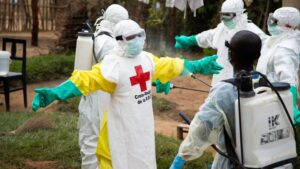
- There has been a declared Ebola outbreak in the east of the Democratic Republic of Congo, which is currently into its fourth month. It is mostly affecting three key provinces (Ituri, Nord-Kivi, Tshopo) but which have to a lesser extent also affected other adjacent provinces.
- So far, the neighbouring countries of Central African Republic, South Sudan, Rwanda and Burundi have not been affected, while Uganda reported a brief and limited outbreak that was declared over on 25 August.
- Médécins sans frontières said in early September that this was still the fastest spreading outbreak in history, while the Congolese health authorities have reported more than 7,000 cases with close to 3,500 deaths.
- Responsible for the new outbreak is a new strain of the Ebola virus called Bundibugyo, for which a new vaccine needs to be developed as the previous Zaire strain cannot be fought with the vaccine developed to count er that particular strain.
On 15 May the public health authorities in the Democratic Republic of Congo declared an outbreak of Ebola. On 17 May the World Health Organisation (WHO) declared the new outbreak, at the time confined to one province in the east of the Democratic Republic of Congo “a public health emergency of international concern”. It started in Ituri Province, where 246 suspected cases had been identified in the preceding days, with 80 deaths suspected to be the result of the new outbreak.
The new outbreak differs from previous ones in the DR Congo or indeed in West Africa as it is a new virus that is causing it. The Bundibugyo virus disease (BVD), as the World Health Organisation calls it, cannot be countered using existing vaccines, such as the one that was developed against the Zaire virus that was virulent in the DR Congo and also responsible for the worst Ebola outbreak to date, in West Africa, where it infected close to 29,000 people and killed more than 11,000 between 2014 and 2016.
The epicentre of this latest BVD outbreak remains the province of Ituri, which borders Uganda and South Sudan. Uganda reported some 20 cases earlier but on 25 August the WHO declared the outbreak over and no new cases have been reported. In the meantime, the disease has spread to five other provinces that either border Ituri or each other. These include Nord-Kivu, Sud-Kivu, Bas-Uélé, Haut-Uélé and Tshopo. These provinces are home to major urban centres like Kisangani, Goma, Bunia and Bukavu. In addition, Haut-Uélé shares a long border with South Sudan while Bas-Uélé has a similarly long border with the Central African Republic. Ituri borders Uganda; Nord-Kivu borders Uganda and Rwanda while Sud-Kivu borders Rwanda and Burundi.
No Ebola cases have been reported from any of the other adjacent countries and there are monitoring systems in place. Health screening takes place at airports and official border crossings but there exists any number of informal border crossings that cannot be monitored. In August, the WHO warned specifically that the disease could spread to South Sudan and the Central African Republic. What these two countries have in common with both Ituri and the two Kivu provinces is instability and insecurity with the constant threat of violence and barely functioning public health systems that are essentially kept afloat with foreign assistance.
Complicating the fight against the new outbreak further is the fact that rebel-held territories in the DR Congo continue to see large-scale population displacements, which potentially increase the risks of the epidemic spreading further. In addition, formal and informal mining operations exist, which tend to attract a large workforce and prostitution, thus increasing the risk of the disease spreading. It must be added, though, that the numbers of people with confirmed BVD in the Sud-Kivu, Bas-Uélé and Haut-Uélé provinces remain relatively low and that the disease is currently at its most dangerous in Ituri, Nord-Kivu and Tshopo.
Having said this, it was the international medical NGO Medecins sans frontières (MSF) that reported on 3 September that this epidemic was still the fastest growing in history and the largest ever in the DR Congo. On 13 September the Congolese health authorities reported that there were now 7,200 recorded cases that had led to 3,475 deaths, a fatality rate of close to 50%, higher than the 40% fatality rate recorded in West Africa, which is still the worst Ebola epidemic on record. 1,611 patients have made a full recovery.
A case that was discovered in the Sud-Ubangi province concerned a young man who had travelled a considerable distance from Sud-Kivu through the DR Congo and Rwanda and Uganda before arriving in the town of Bula, in Sud-Ubangi, where he died. This discovery in a province not adjacent to the epicentre suggests that there is a contact-tracing program in place, similar to the ones employed in Nigeria, Côte d’Ivoire and Senegal in 2014-16, which prevented the virus from spreading beyond its epicentre. The one case in Sud-Ubangi may remain the only one that will be recorded in that province.
This does not take away from the practical circumstance that in general terms the public health infrastructure in the Democratic Republic of Congo is poor, reliant on dwindling foreign assistance – 40% of the DRC’s health budget is donor-funded – with inadequate disease monitoring and clinical facilities. An added complication is the intermittent flare-up of hostility against medical teams and their facilities on the part of the local population. As was the case in Guinea in 2014-16, health facilities in the DR Congo have been attacked and even destroyed and attempts to safely bury those who had succumbed to the BVD were attacked, rendering safe burial more difficult.
The Congolese government said on 11 September that the epidemic was ‘under control’, an assessment that is not corroborated by reports from the area, MSF or the WHO. There may be a decline in some areas but the occurrence of BVD may peak at different times in different places; there is no room for complacency, even when the European Centre for Disease Prevention and Control still estimates that the risks for countries in the European Union are low to very low, as are the risks for other parts of the African continent. However, as the West Africa example has shown, geographical isolation of the kind that obtains in remote Guinea, Liberia and Sierra Leone – as it does in many parts of eastern DR Congo – does not prevent the virus from traveling. International health workers are a particular at-risk group and the usual precautions are in place for those returning from affected areas.
Clinical trial runs are under way, in preparation for a possible vaccine against the Bundibugyo strain of the Ebola virus but these are still in the early stages. Given the instability and uncertainty, compounded by the presence of Rwanda-backed M-23 rebels in the Kivu Provinces and now this latest outbreak, it is prudent to avoid traveling to these areas under the current circumstances. In the longer run and given the funding gaps that will continue to affect international health systems there is a good argument to be made in favour of creating autonomous community-based health initiatives with an emphasis on sensibilisation and prevention.