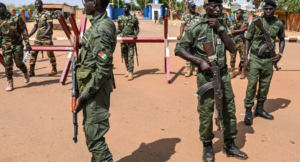
- A mutiny by Niger’s Special Forces against the Presidential Guard on 29 August was suppressed within 24 hours with Russian (Africa Corps) and Algerian military support.
- The episode exposes deep structural rifts and command weaknesses in the Nigerien army, undermining its ability to counter jihadist attacks near the capital.
- Algeria’s involvement is driven by three factors: preventing jihadist spillover (security), oil exploration and fuel supply (business), and better diplomatic ties with Niger than with Mali.
- The AES (Alliance of Sahel States) appears weakened: its standby force failed to respond, and divergent North African influences (Algeria–Niger vs. Morocco–Mali) may create future strains, though no internal AES tensions are evident yet.
- Business outlook: the oil sector has promise due to Algerian engagement and possible Benin border resolution, but uranium extraction is stalled, and overall instability advises short-to-medium-term caution.
An army mutiny erupted on the evening of 29 August but was quelled within 24 hours by the Presidential Guard, with help from Russian forces and Algerian air cover. The mutiny started within the Special Forces, pitting them against the Presidential Guard, which is primarily tasked with protecting junta leader General Abdourahamane Tiani. The confrontation hints at structural divisions and weaknesses in the Nigerien army, rendering it less effective in dealing with Islamist extremists who continue to stage attacks quite close to the capital, Niamey.
Algeria has staked its geopolitical, diplomatic and business claims in Niger by lending it military assistance, providing it with fuel, investing in oil exploration, and offering cooperation in a variety of fields, especially developing oil-related downstream industries. The AES emerges weakened from the episode, having failed to provide assistance via a theoretical 5,000-strong standby force that is facing difficulties, and by allowing Algerian and Moroccan geopolitical and commercial interests to exert potentially divergent influence on two key AES members, Mali and Niger. However, there are currently no signs of internal tensions within the AES as a result of these North African influences.
On the evening of Saturday 29 August, gunfire was heard at Base 101, in the vicinity of Diori Hamani International Airport near the Nigerien capital, Niamey. It was the third time the airport came under attack this year, but while responsibility for the two earlier incidents (in January and June) could be credibly ascribed to Islamist insurgents, this latest attack was carried out by Nigerien soldiers, principally from the Special Forces tasked with fighting insurgents in various parts of the country. The troops had aired grievances on previous occasions, citing heavy losses during terrorist attacks on their camps (more than 200 soldiers have lost their lives in 2026 so far) and their inability to mount a credible defence due to a lack of equipment and the absence of air cover. The troops were also unhappy with the preferential treatment accorded to military personnel close to the ruling elites, and with the behaviour of Russian troops from the Africa Corps (the former Wagner mercenary outfit) stationed in Niger.
There were also tensions with the Presidential Guard protecting General Abdourahamane Tiani, in power since his July 2023 coup—which he launched while he was head of the Presidential Guard and tasked with protecting the man he deposed, former president Mohamed Bazoum. In this case, the mutiny was threatening to morph into yet another coup, but as they were attempting to target the presidential palace and the national broadcaster, the Special Forces found themselves confronted by the Presidential Guard and the Africa Corps, who put down the mutiny within 24 hours. International observers have noted two intriguing details: General Tiani has not been seen in public since the mutiny began, and no casualty figures have been supplied.
Hitherto considered the best-organised and relatively disciplined military among the three AES member states (Mali, Burkina Faso and Niger), the army now emerges as having to rely on foreign support to maintain General Tiani’s junta in power. Particularly worrying is the rift between the Special Forces and the Presidential Guard. An army may have several units that operate with relative autonomy, but ultimately it is a unified command-and-control structure that determines its effectiveness. This mutiny suggests such a structure can no longer be considered a given, which should worry the top of Niger’s military hierarchy. Army division and disarray against the backdrop of a leader who came to power unconstitutionally comes at a particularly bad moment for national security and regime stability. Failure to address the Special Forces’ complaints about their working conditions may negatively impact overall combat readiness, as terrorist attacks from Al Qaeda and Islamic State-aligned groups show few signs of abating. These attacks have been heavily concentrated in the Tilaberi and Dosso areas, equidistant from the capital Niamey to the northwest and southeast respectively, but at 130 kilometres, worryingly close to the Nigerien capital.
To quell the mutiny, the junta not only had to call in the Africa Corps; Algeria played a similarly important role in maintaining the status quo. Algiers sent four Sukhoi-30 fighter jets piloted by its own personnel—the first time they were deployed outside Algerian airspace—along with attack helicopters and a refuelling plane. Notable by their absence were troops from the other two AES member states, which are supposed to be on standby in similar situations—hinting at operational problems with the supposedly 5,000-strong joint intervention force.
Algeria’s policies are informed by self-preservation, which first and foremost means keeping armed Islamist extremists off its territory. This posture is fully informed by the trauma of the 1992–2002 civil war, which may have cost as many as 200,000 lives. Algeria’s security establishment has always held Islamist militants responsible for the war and has anchored its domestic and regional foreign policies on preventing a recurrence. It dislodged the Armed Islamic Group, sent its fighters into the Sahel, and is working to prevent their return. Aiding Niger is part of this strategy.
The second element is business-oriented. The giant state-controlled oil company Sonatrach has resumed exploration in the Kafra region and is preparing more activity near Agadez. Algiers has begun sending Jet A1 fuel to Niger and may be working on modernising oil refineries and building a petrochemical complex in Zinder and Dosso, respectively. Stability is a precondition for these industries to come onstream.
The contrast in approach with Algeria’s other Sahelian neighbour, Mali, has been stark, and it is diplomacy—the third element—that can explain this. While Mali’s ruling junta under General Assimi Goïta has annoyed Algiers by tearing up the 2015 Algiers Peace Accord and restarting its war with the Tuareg rebels of the Front for the Liberation of Azawad, Niger’s junta is concentrating on the jihadist menace, leaving the nascent and very small Tuareg rebel movement to its own devices for now. Niger has also steered clear of the second bone of contention between Bamako and Algiers: Goïta’s junta’s recognition of Morocco’s de facto occupation of Western Sahara, to which Algeria is vehemently opposed. There is no sign that the very different relations between Algeria and Mali, on one hand, and Algeria and Niger, on the other, are leading to tensions inside the AES; Mali and Algeria have also begun mending fences. However, it cannot be excluded that Morocco’s emphatic rapprochement with Mali will have a destabilising impact on the AES as a whole beyond the short term.
Instability is likely to persist in Niger, but some business sectors and cross-border trade with Nigeria will do well. The oil sector is likely to flourish, not only as a result of Algeria’s renewed engagement but also because the arrival of Romuald Wadagni as the new president of Benin has renewed prospects that the long-standing border issues between Niger and Benin are getting closer to being resolved. This may finally see the full resumption of oil deliveries to the dedicated terminal in Benin from the Agadem oil field through the Chinese-built and -operated 1,950-kilometre-long pipeline. These deliveries have been frequently disrupted, owing to sabotage, rebel attacks, and tensions between the Tiani-led junta and the government of former Beninese president Patrice Talon. Pending future improvements in the security situation, investments in oil and oil-related industries in Niger have a good chance of delivering returns.
More complicated is the situation regarding uranium extraction. Having removed the French company Orano from its mine in the north—the only operational uranium mine in the country—and granted its licenses to national entities, the junta now faces a halt in extraction, and the uranium destined for export remains blocked at Niamey’s international airport. Negotiations are ongoing for new extraction operations, and at least two new permits were granted in August (one to a state-run company), but for the time being, output from Niger is basically nil. For the short and medium term, business attention should probably focus elsewhere.
For tailored analysis on governance, politics, economy, diplomacy, and trade, please contact Africa Investigates Incorporated.
Email: africainvestigates2020@gmail.com
Tel: +221785282247