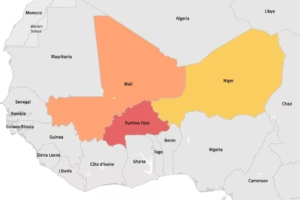
- Armed groups and Tuareg rebel movements continue attacks across Mali, Burkina Faso, and Niger. Neither side can win outright—insurgents lack the force to take capitals, while juntas cannot re‑establish full state control—resulting in a prolonged, stagnant, and geographically spreading conflict.
- The three military rulers are primarily focused on retaining power.
- Russia provides military hardware and personal security to two junta leaders, Turkey supplies armed drones, and Algeria acts to protect its own borders and energy interests.
- A popular uprising is unlikely due to effective surveillance and Russian‑backed repression; the most plausible scenario is prolonged “muddling through.”
- Re‑entry into ECOWAS is not on the cards while juntas remain. Intermittent discreet contacts exist, but no regional security cooperation has been restored.
The Al Qaeda and Islamic State affiliated armed non-state groups continue in all three countries of the Central Sahel namely Mali, Burkina Faso and Niger, while two Tuareg rebel movements in Mali and Niger continue to stage attacks.
The military juntas running these three countries are uncompromising in their desire to maintain themselves in power; it is their overriding concern.
Those currently or formerly in alliances or maintaining a variety of other relationships with the military juntas such as Algeria, Morocco, the Economic Community of West African States, the European Union, the United States, Russia, Turkey or China pursue their own interests, which rarely coincide with the interests of the people in these three countries.
The conflicts are set to continue, as the insurgents and rebels feel the momentum is with them. However, they lack the force and the internal administrative infrastructure to be able to take over any of the three countries and dislodge the juntas.
Given its instability and the volatility of the regulatory environment, the three countries in the region of the Central Sahel cannot currently be considered safe for major investments.
The conflicts are stagnant at best and steadily spreading
The conflicts between governments and various non-state armed insurgents have been a reality for the populations of Mali, Burkina Faso and Niger for a decade and a half; they are highly unlikely to be either solved or concluded in the foreseeable future. The occurrence of five coups d’états between 2020 and 2023 that brought General Assimi Goïta, Captain Ibrahim Traoré and General Abdourahamane Tiani has led to a perceptible deterioration of the security situation in all three countries.
In April 2026, the Front de Libération de l‘Azawad (FLA) recaptured the key strategic town of Kidal in Mali and since 2024, the Mouvement Patriotique pour la Liberté et la Justice (MPLJ) has staged attacks in northern Niger. Meanwhile, violence orchestrated by armed groups continues to occur in all three countries, with the Islamic State particularly active in the vast border area of Mali, Burkina Faso and Niger. Al Qaeda-affiliated groups like JNIM (Jama’at Nusrat wa-Islam wal Muslimin) are staging attacks throughout most of the three countries, sometimes straying into Togo and Benin in particular, as a punishment for their real or perceived support for the Sahel juntas.
In all three countries, independent reporting on the conflicts is impossible. Information relies on local sources who share what they see and hear about the actual state of affairs, often at great risk to themselves. Earlier this week, two Malian media personalities (Mohammed Youssou Bathily, known in Mali as ‘Ras Bath’ and Rokia Doumbia) were sentenced to ten years in prison for pointing out that Mali’s economy is in a bad state, the cost of living is too high and people are suffering as a result. The three ruling juntas offer attractive rhetoric that is not matched by realities on the ground and mete out severe repression against those who point this out. Among the charges laid against Bathily and Doumbia was that of being part of a ‘criminal conspiracy’.
All key players, domestic and foreign, follow their own interests
The three military juntas maintain varying relations with major regional and international actors. Russia is perceived the main military sponsor of the juntas, providing hardware to all three, some combat support to Mali and guaranteeing the personal security of Assimi Goïta and Ibrahim Traoré. It is unknown whether there is a Russian security presence around Abdourahamane Tiani. Expanding its geopolitical footprint and disrupting West Africa are the main drivers of Russian engagement in the central Sahel. Turkey has emerged as an important provider of armed drones.
Algeria is the most powerful military presence in northwest Africa and its actions are driven by self-preservation, wishing to keep armed insurgents away from its territory and securing its border with Mali. The incident with a Malian drone Algeria alleges was shot down over its territory in April 2025, a charge Mali denies, illustrates the tensions between the two countries, which predate the arrival of the current junta. Niger and Algeria maintain better relations: recent reports indicate that Algeria has gifted four attack helicopters to Niger; the Algerian state oil company Sonatrach is reported to have begun exploration in the Kafra region (a resumption of earlier work it did in Niger) and is now delivering Jet A1 fuel to Niger.
All this points to a diminished relevance of the West, where the fight against terrorism is concentrated in occasional visits of French and US officials to, among others, Nigeria and Côte d’Ivoire.
Possible scenarios, roads that may or may not be taken
Given that the military juntas have an effective surveillance and repression system at their disposal, thanks to Russian support, the chances of a popular uprising of the kind that removed Moussa Traoré from power in Mali in 1991 or Blaise Compaoré in Burkina Faso in 2014 is remote. If there is a threat to any of the three junta leaders and the closed circles around them, it will come from the armed forces, where discontent is rife over a misguided military doctrine for fighting asymmetrical wars, the ensuing poor results and most of all, insufficient remuneration. The most likely scenario, therefore, is one where this is an extended period of muddling through where few if any substantial changes occur. The military situation corroborates this scenario.
Historically, the absence of tangible progress towards solving the multiple insurgency problem militarily compelled civil society in Mali, Burkina Faso and Niger to push for dialogue with the violent non-state groups and there have been instances at the beginnings of these dialogues, like the one facilitated by the conservative Malian cleric Mahmoud Dicko during the reign of the late president Ibrahim Boubacar Keita. However, any talk of such dialogue is now entirely proscribed by the military regimes. The outlook is therefore one of prolonged asymmetrical conflict, with the state unable to impose its authority throughout the entirety of the three territories and the insurgent groups unable or unwilling to take full control of these territories but continuing to exert pressure on the juntas by staging intermittent attacks.
Regionally, the 12-member Economic Community of West African States, in which Nigeria, Côte d’Ivoire, Ghana and Senegal hold influential positions remains open to the re-entry of Mali, Burkina Faso and Niger, now in the Alliance of Sahel States (AES) into the regional body but as long as the juntas remain in place this is not on the cards, given their public hostility to ECOWAS’ supranational authority.
There are, however, instances of intermittent discreet contacts between AES member states and some ECOWAS countries such as Senegal and Mali, Côte d’Ivoire and Burkina Faso, Ghana and Burkina Faso, Niger and Benin but they have not led to the restoration of a regional security architecture that existed before the creation of the AES, especially in the area of intelligence sharing. From the point of view of the JNIM, overt support for any of the three juntas –as Togo seems to be providing –is punishable by incursions, of which Togo has suffered disproportionally. The arrival of Romuald Wadagni as president of Benin has led to more relaxed relations between that country and the AES but Benin remains vulnerable, as it is a transit zone for violent non-state groups in Burkina Faso, Niger and Nigeria.
Given this outlook of prolonged instability and fiscal strain, the juntas will inevitably turn to squeezing existing revenue sources, making the investment climate particularly hazardous.
Actionable advisories
Investors must refrain from investing in a volatile and unpredictable environment; there are mining companies that have moved out or only stay after a thorough cost-benefit assessment; the juntas are short of money and have limited sources of revenue (mining, cotton) or other forms of financing (the regional WAMU market). They will continue to attempt to either extract more concessions out of existing operations or increase taxation. State-owned companies from China and Algeria or large international (gold) mining houses with long-standing experience in difficult negotiations are among the few that have the means and the backup to make and preserve their investments.
For tailored analysis on governance, politics, economy, diplomacy, and trade, please contact Africa Investigates Incorporated.
Email: africainvestigates2020@gmail.com
Tel: +221785282247