
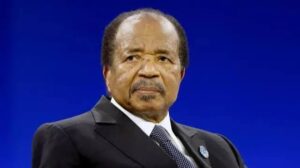
- The 93‑year‑old president has been away from Cameroon for over two months (in Geneva), fuelling succession speculation, though the government insists he remains in control.
- Biya has repeatedly rotated top generals, particularly after the 2023 Gabon coup, to discourage a military takeover; the immediate coup threat is considered low.
- Key players (Ngoh Ngoh, Mvondo Ayolo) compete for influence, but First Lady Chantal Biya has become a decisive arbiter, while the revived Vice President post may signal a path for Biya’s son.
- Growth holds at 3‑4%, but $9 billion in funds are unspent, the IMF is wary of fiscal stress, and corruption and inequality remain deeply entrenched.
- Defer major capital commitments until succession clarity emerges, monitor IMF relations closely, and avoid heavy exposure to state‑linked contracts due to corruption risks.
President Paul Biya has been out of public view and away from Cameroon for more than two months, giving rise to speculation about his health. The government maintains that he is well and in control – and that he will soon return. Now in his eighth successive term, the 93‑year‑old leader resides in Geneva, reportedly undergoing undisclosed medical treatment. Government spokesman René Emmanuel Sadi assured media in early August that Biya would return, though he stopped short of providing a date.
Military reshuffles prevent coup risk
One sign of Biya’s continued control is an ongoing reshuffle of high‑ranking officers in Cameroon’s armed forces, which are fighting insurgencies in the extreme north and the southeast. These moves are widely interpreted as Biya’s response to the August 2023 coup in neighbouring Gabon, which removed the Bongo Ondimba family after 56 years. The latest reshuffle, in August 2026, placed new brigadier generals in sensitive zones, including the capital district, the border with the Central African Republic, and the two conflict zones. The long‑serving head of the presidential guard was also elevated. Similar reshuffles occurred in July 2025 and late 2024. This strategy of rotating top commanders is a tried method of preventing coups, and so far it has served Biya well; we consider the risk of a military takeover remote.
Inner‑circle power struggles
With Biya’s perceived frailty, various groups close to him have been positioning themselves for the succession. The principal players are Ferdinand Ngoh Ngoh, Secretary‑General to the Presidency since 2011, and Samuel Mvondo Ayolo, Director of the President’s Civil Cabinet, a former ambassador to France recalled in 2017. Both men hold the key asset of direct access to Biya. However, Chantal Biya, the president’s wife since 1994, has emerged as a likely arbiter of the succession, particularly regarding access to her husband. She has not publicly declared a preferred faction, but she proved her influence by securing the dismissal of a top security advisor, Rear Admiral Joseph Fouda, in October 2024 after he publicly disagreed with her. Speculation also surrounds the re‑creation of the Vice President post, which some interpret as a stepping stone for Biya’s son, Franck Emmanuel Biya, from his first marriage – though much depends on whether Chantal Biya would support such an ascension.
Economy resilient but governance weak
Cameroon’s nearly $50 billion commodity and services‑based economy, the largest in the CEMAC zone, performs reasonably well at a modest but steady annual growth rate of 3‑4%. The government reported $13 billion in investments in 2025, mainly in infrastructure and transport, though 2026 does not appear on track to match that figure.
Conversely, the government underperforms in critical areas. An estimated $9 billion in earmarked project funds remain unspent. The IMF, which supplies roughly 10% of the annual state budget, is not in a hurry to conclude new agreements, raising fears of fiscal stress. The Fund classifies Cameroon as a fragile and conflict‑affected state, describes many state‑owned enterprises as weakly governed, and views procurement procedures as slow and cumbersome. Corruption is entrenched, inequality has increased, and public unrest flared after Biya’s controversial re‑election in October 2025. Meanwhile, two violent insurgencies – one involving Islamic State militants in the north, and the other with anglophone separatists in the southwest – persist, consuming significant state resources and showing no signs of abating.
The succession issue and the ongoing positioning of key figures continue to hinder decisive policy‑making that could address these problems.
Investor caution advised
Given the uncertainties surrounding the presidency and the government’s limited capacity to act decisively, investors would be wise to defer major capital commitments until the succession is clarified and the government demonstrates effective policy‑making. It is also useful to monitor the IMF’s stance toward Cameroon as a bellwether of fiscal health. Finally, because corruption remains serious, investors should exercise caution when engaging with state‑linked operators and diversify exposure away from state‑linked contracts where possible.
For tailored analysis, please contact Africa Investigates Incorporated.
Email: africainvestigates2020@gmail.com
Tel: +221785282247