
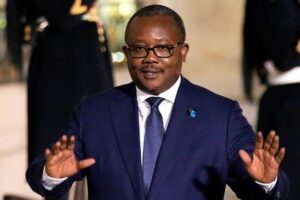
- A new Constitution will be voted in on August 30; it contains all items on former president Umaru Sissoco Embaló’s wish list.
- General elections will be held on December 6 but these may be delayed.
- Both referendum and elections, prepared by a transitional government that is led by friends and allies of Embaló’s, will pave the way for the return of the former president.
- A renewed Embaló presidency will lack the guardrails that could prevent the descent of the country into a repressive autocracy captured by local and international criminals.
- The economy, entirely dependent on cashew exports, will suffer extended stagnation.
- The people of Guinea Bissau will see their living conditions, already compromised under the years of Embaló’s regime and the current military junta deteriorate further.
Introduction and summary
The former president of Guinea Bissau, Umaru Sissoco Embaló has resurfaced on the international scene. He is supporting the bid of his old friend, Senegal’s ex-president Macky Sall, to become the next Secretary-General of the United Nations. Embaló, who was deposed in a November 2025 coup that prevented the putative winner of the presidential elections Fernando Dias da Costa to take office, lives in exile in Morocco, where he is preparing his return to the political scene in Guinea Bissau; his very public support of Sall is designed to lend weight to that effort. Fresh general elections have been slated for December 6 this year. These elections will be held within the framework of a new Constitution, the subject of a referendum on August 30. The new constitution expands presidential powers and limits the ability of parliament to hold the executive to account. We will explain what the return of Embaló will mean for the country and its neighbours.
A referendum to please a ‘deposed’ president
Guinea Bissau is preparing for a referendum on the new Constitution, which appears to confirm the hypothesis that it paves the way for the return of the autocrat Umaro Sissoco Embaló. Under the new constitution, the president will have the power to dissolve parliament at any time, appoint and dismiss the prime minister and oversee the two bodies that appoint judges and manage the public prosecution. Parliament’s powers of oversight will be severely restricted and the name will change from Assembleia Nacional Popular to simply Assembleia Nacional.
While in power, Embaló already captured the highest civilian court (Supremo Tribunal de Justiça, STJ) in 2023 by hounding its president (José Pedro Sambu) out of office and have him replaced with a loyalist, André Antonio Lima. With the diminution of the stature of parliament and control of the civilian judiciary, the Executive will have complete control over all three branches of government, which is entirely in keeping with Embaó’s wishes.
There was no coup in November 2025…
Activists from the country’s established political parties have maintained that it was the former president himself who engineered the November 2025 coup and it is not just the contents of the new Constitution that point in that direction. The coup began with an attack on the offices of the Comissão Nacional de Eleições, the National Elections Commission, during which all election-related material, including the results, was allegedly – and conveniently – destroyed, forever burying the definitive answer to the question whether it was indeed Dias da Costa or Embaló who won that election.
Then, when the leaders of the military junta emerged (the Alto Comando Militar para a Restauração da Segurança Nacional e Ordem Pública or the High Military Command for Restoring National Security and Public Order), it was immediately apparent that these were close allies of Embaló, himself an army general. General Horta Inta-a, the leader of the Alto Comando Militar went on to create an interim parliament, the Conselho National de Transição (CNT), which approved the text for the new Constitution. The leader of the CNT is a major-general, Tomás Djassi. Both Horta and Djassi were deeply involved with the Presidential Guard that prevented Embaló from being killed in a five-hour gun battle in February 2022, when armed balaclava-clad criminals attacked the cabinet meeting Embaló was chairing. The presidential camp was quick to frame the battle as another coup attempt but observers were not convinced and saw the firefight as an attempted settlement of scores in the drugs trafficking circuit, signalling that the Guinea Bissau government was implicated at the highest level. The involvement of the armed forces in the trafficking of cocaine has been public knowledge for almost 20 years.
More repression in a rogue state
Today, Guinea Bissau is labouring under the most repressive military dictatorship in decades, which has set an unrealistic time-table for the return to a simulacrum of democracy by year-end. The August 30 referendum will see the new Constitution come into effect, heralding (depending on when elections will be held) the return of Embaló and his repressive rule. Further confirmation of this scenario, apart from the disappearance of the November 2025 electoral results, is the treatment of Domingo Simões Perreira, a reform-minded politician from the former ruling PAIGC party (Partido Africano da independência de Guiné e Cabo Verde) and the Speaker of the kast ANP that Embaló dissolved, twice. Having been accused of preparing a coup that the November coup of Horta and Djassi prevented, Simões Perreira was incarcerated in a military prison, then given house arrest in January, and again arrested on July 10. He was released on July 22 and is undergoing medical treatment in Portugal but banned from any political activity. He has vowed to return to Guinea Bissau, to take on the generals. He is working in a coalition of like-minded parties, all of which were destroyed from within by Embaló’s machinations during his last two years in power.
A renewed Embaló presidency will close down all remaining political and media space and lead to further state capture by Latin American drugs barons who have financial means that surpass the country’s GDP. The resulting perennial instability will scare away bona fide investors and stymie the country’s legitimate economy, which desperately needs diversification away from the cashew export, upon which the country depends for its income. The people of Guinea Bissau will not see their living standards improve but apart from sporadic strike action that can only be conducted by unionised salaried workers, a minority, and given the extreme levels of repression in the country there is little chance of widespread public unrest or a Burkina Faso 2014-style uprising.
Regionally, Guinea Bissau will increasingly be seen as the hub of criminal networks stretching from Venezuela to Mali. Sissoco, who is part Malian, allowed the revival of old trade routes dating back to the Mali Empire, of which Gabú in Guinea Bissau was a part, for all manner of contraband operations. Guinea Bissau military have repeatedly been reported to be complicit in the cocaine trade and the depletion of the redwood forests, with timber smuggling operations into neighbouring Senegal and through Gambia. Guinea Bissau’s rapprochement with Russia, Turkey and China also point into the direction of a state marked by violent repression of dissent.
For tailored analysis on governance, politics, and Guinea Bissau’s economy, please contact Africa Investigates Incorporated.
Email: africainvestigates2020@gmail.com
Tel: +221785282247