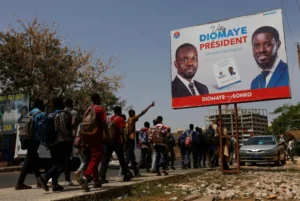
- The definitive rift between Pastef leader Ousmane Sonko and president Bassirou Diomaye Faye has derailed the political, legal and social reform agenda that brought Pastef to dominance in Senegalese politics
- Senegal faces a period of political instability, as the Sonko – Faye split works its way through the preparation process for the 2029 presidential election, which they will both contest.
- Oil, gas and mining contracts are unlikely to be affected.
- But social instability may ensue as Senegal’s economy stagnates, the cost of living rises and jobs fail to materialise.
Bassirou Diomaye Faye, the presidential candidate of Pastef (Patriotes africains du Sénégal pour le travail, l’éthique et la fraternité), the party he and party leader Ousmane Sonko founded in 2014, swept to power after a violently turbulent pre-election period. Faye’s victory in February 2024 came on a wave of public disgust with the repressive nature of former president Macky Sall’s government and Sall’s disrespect for Senegal’s Constitution. Sall had attempted to extend his rule beyond constitutionally allowed limits, which is anathema in Senegalese society.
Sonko and Faye, both devout Muslims, both former tax inspectors and described in the authoritative bi-weekly Africa Confidential as “the closest of allies” went on to win a supermajority in the Assemblée nationale, Senegal’s legislative body, in November 2024, gaining 130 of the 165 parliamentary seats.
Pastef appealed especially to the young with its agenda of job creation, its stance against corruption (including thorough reform of campaign financing rules), its promise to bring down the cost of living, its pledge to reform the justice system and its stated intention to review the oil, gas and mining contracts the Sall government had signed, even though such moves are certain to be challenged in court by the companies involved.
But then, in March 2025, an audit of the financial records of the previous government revealed a hidden debt of an estimated $7 billion, bringing Senegal’s total debt burden to a staggering 132% of GDP, the highest on the African continent. The Sall government had not disclosed this and it left the new government blindsided. The IMF, one of Senegal’s principal financiers, demanded measures to deal with the new situation, pending and withheld $ 1.8 billion in much-needed financial support. At this point, Senegal can only borrow money on the regional WAMU market, which does not have limitless reserves.
The debt crisis brought the differences between Faye and Sonko to the fore. Faye, along with his finance minister Cheikh Diba took a pragmatic line and argued in favor of negotiating a way out with the IMF while Sonko, well-known for his populist stance on many issues, emphasized national sovereignty and finding a solution without the IMF.
The two men assumed two distinct roles: Sonko and his party could play the opposition and feed their base with populist messages (including fomenting and ramping up Pastef’s violent homophobia), while Faye had to govern the country and manage its international relations. This gives the latter a more statesmanlike stature but puts him at a political disadvantage.
The differences escalated in 2026, leading to Faye firing Sonko as prime minister on May 22. In keeping with his perceived pragmatism, Faye appointed the financially conservative Ahmadou Mohamed Lô in Sonko’s place, clearly an attempt to open avenues of dialogue with the IMF. Lô heads a 30-strong cabinet, in which Pastef’s is minimally represented. Other cabinet members come from former president Sall’s government. Sonko replied by making himself president of the National Assembly on May 26. The definitive split came on June 6 this year, when Sonko headed Pastef’s congress without Faye being present and then on July 3, when Faye announced the creation of his own party, thus also confirming that he is determined to hold on to his job as Senegal’s fifth post-independence president.
The standoff has morphed into open rivalry and looks like this. Faye controls the executive branch and thus the government, while Sonko controls the legislative body. Theoretically, Faye can dissolve the National Assembly and call for fresh elections, which will almost certainly lead to Sonko retaining Pastef’s unassailable parliamentary majority. Or Sonko can begin impeachment procedures against Faye, which will be lengthy and politically damaging and tarnishes Senegal’s standing in the region and the world. The upshot is that until the two most powerful men in Senegalese politics and their movements go head to head in 2029, which is a near-certainty, progress will be piecemeal and based on wringing out compromises on individual issues.
The stalemate affects Pastef’s plans to reform the country’s legal and political system, creating a Constitutional Court and reducing the president’s powers. While commendable and enjoying wide support, the reforms are now seen as Sonko’s efforts to use his parliamentary majority to go after Faye, who has redirected these reforms towards subjecting them to a potential referendum later this year.
Meanwhile, Senegal’s economy underperforms at a projected rate of 2%-3% for 2026, well below what the now constant oil and gas revenues from the operational offshore fields would suggest. In addition, the debt crisis remains unresolved, austerity bites, the cost of living increases and the promised jobs remain elusive.
For tailored analysis on governance, politics, and Senegal’s economy, please contact Africa Investigates Incorporated.
Email: africainvestigates2020@gmail.com
Tel: +221785282247