-
A French court granted an exequatur on July 15, 2024, recognizing an ECOWAS Court judgment against Guinea for the 2012 Zogota massacre, allowing enforcement of the $450,000 award via seizure of Guinean state assets in France.
-
The ruling creates a cross-border enforcement precedent, warning West African states that ECOWAS human rights verdicts can now be executed in European jurisdictions, potentially incentivizing compliance with regional rulings.
-
The case highlights legal risks for mining companies, as human rights violations in weak-governance states can lead to asset seizures in Europe, making community engagement and de-escalation critical to avoid long-term liability.
-
Simandou’s operators face heightened scrutiny, as documented patterns of environmental harm, displacement, unfulfilled promises, and security force violence mirror Zogota, and affected communities could follow the same legal roadmap.
-
The precedent shifts the extractive sector’s risk landscape by proving that local grievances are no longer locally contained, and that complicity with abusive state forces can create enforceable legal consequences far beyond the host country.
In August 2012, members of the Guinean armed forces and police killed six people and damaged property in the town of Zogota. Almost fourteen years after the facts, justice may finally begin to be delivered to the survivors, through a French court. What if any are the consequences for other mining operations?
In early August 2012, the inhabitants of Zogota, a small forest town in the deep southeast of Guinea, briefly occupied an iron ore mining site that was being developed by VBG, a joint venture between the iron ore giant Vale of Brazil and the Franco-Israeli diamond tycoon Beny Steinmetz. They wanted to have their complaints about the company’s practices on and off the site listened to.
The people claimed that the development of the mine harmed the environment and that its operations had damaged sites they consider sacred; often these are sites associated with local religions, beliefs and traditions that revolve around respect for the ancestors. They also wanted to know when the jobs that the company had promised to young people were going to materialise. Finally, they were upset about the embezzlement, allegedly by local officials, of development funds that VBG had reportedly paid.
These things happened frequently in places where mine developments take place and the resulting grievances of local people are rarely if ever taken into account. Zogota, however, was prepared to signal that enough was enough. Hence the site occupation, which by most accounts passed off peacefully, even though the protesters did prevent personnel from entering the site. VBG claimed the site was being vandalised and called in Guinean security forces. Meanwhile, local mediators ended the site occupation by brokering a deal in which the company and the townsfolk were going to have the talks the people of Zogota had been asking for. Instead, something else happened.
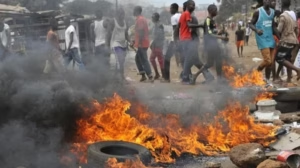
In the early hours of the morning of August 4, 2012, soldiers, gendarmes and police entered Zogota, fired shots, burned homes, arrested and abducted several individuals (there are allegations that they were tortured) and when they were done five people were dead; a sixth died later.
That same month, Frédéric Loua Foromo, a Guinean lawyer, lodged complaints against members of those security forces and took them to court in 2013, on behalf of the survivors of the Zogota Massacre and with MDT (Les mêmes droits pour tous – The Same Rights for All), a local human rights NGO. They also took legal action against VBG, for collaborating with the security forces.
No Guinean court, military or civilian, made the case move forward and so in 2018, with the help of the Ghanaian-USA group Advocates for Community Alternatives (ACA), the Zogota survivors and MDT went to a regional Court of Justice in Abuja, Nigeria, to obtain redress. Charges were laid against the state of Guinea and included violations to the right to life, torture, other degrading treatment and unlawful detention. In principle, this court, run by the regional body ECOWAS (the Economic Community of West African States) has the authority to compel member states to undertake certain actions if and when so ordered by the Court. On November 10, 2020, the ECOWAS Court ordered Guinea to pay the equivalent of just under $450,000 to the survivors and relatives of those who had perished in Zogota. Guinea never complied. And so, in August 2024, a full ten years after the massacre happened, the survivors, MDT and ACA took their case to a French Court, in order to obtain what is known as an exequatur, which means that, if granted, a decision made by a court outside France (in this case the ECOWAS Court of Justice) can be forcibly carried out in France. With the added assistance of the French pro-transparency group Sherpa, they obtained this exequatur on July 15, at the Paris Court of Justice, the first time a French court recognises a verdict passed by a regional foreign court.
ECOWAS Court judgments are routinely ignored by member states, as they lack direct enforcement mechanisms; hence the need for the French legal route.
Beyond this case, the Paris ruling sends a powerful signal—not just to Guinea, but to every state operating within reach of European jurisdictions, and to every multinational extractive company that assumes local grievances will remain local.
A warning to states
Sherpa argues that the exequatur fundamentally alters the calculus for non-compliant states. “It is a signal to governments that human rights verdicts rendered against them can now be executed beyond their borders, in jurisdictions where they hold assets. This may incentivize states to respect ECOWAS rulings or, ideally, to honor their human rights obligations preemptively, to avoid condemnation altogether.”
The practical risk for Guinea is now tangible.
While the $450,000 award is modest, the principle is not. If Conakry fails to pay, French courts could authorize the seizure of Guinean state assets in France—whether bank accounts, commercial properties, or even shares in state-owned enterprises with French subsidiaries. Embassy and consular buildings are immune, but many other assets are not. The process is lengthy and will almost certainly be litigated, but as Frédéric Loua Foromo told Guinean media: “Hope is now permitted.” For other West African states with properties, investments, or debt obligations in France—or indeed in any EU country that recognizes similar exequatur procedures, the precedent is uncomfortable. A ruling against them in Abuja or Accra may no longer be safely ignored.
Deepening the Simandou parallel: a cautionary mirror
The comparison with Simandou, Guinea’s colossal $23-billion iron ore project, is not merely rhetorical—it is grounded in documented patterns. At Simandou, local communities have reported:
- Environmental degradation similar to Zogota, including destruction of sacred sites and farmland;
- Displacement of entire villages with inadequate or non-existent compensation;
- Unfulfilled employment promises, mirroring the Zogota grievance that jobs never materialised;
- Heavy-handed state security responses to peaceful protests, including arrests, beatings, and property destruction, documented by human rights groups such as Amnesty International and local Guinean NGOs.
Moreover, the systems of redress at Simandou—where they exist at all—have been widely criticized as insufficient. Company-sponsored grievance mechanisms are often slow, opaque, and perceived as biased. State-led investigations rarely proceed. And as with Zogota, the collusion between private enterprise and state security forces creates a formidable barrier to accountability.
The Zogota ruling does not directly implicate Simandou’s current operators—among them Rio Tinto, Chalco, and the Guinean state itself. But it establishes a legal roadmap that Simandou’s affected communities could follow: exhaust local remedies, seek regional judgment, and then pursue enforcement in a jurisdiction where the state or its corporate partners hold assets. If Guinean state assets in France are seizable today, how long before similar actions target the European holdings of mining conglomerates with indirect state links?
A new reality for the extractive sector
For mining companies operating in high-risk, weak-governance environments, the Zogota precedent shifts the risk landscape in three critical ways:
- Legal risk is no longer local. A human rights violation in a remote Guinean forest can now lead to asset seizures in Paris, London, or beyond. Companies cannot assume that host-state impunity shields them from cross-border consequences.
- Due diligence must include community engagement, not just compliance checklists. The Zogota tragedy was not caused by a failure to file environmental impact assessments—it was caused by a failure to listen, to deliver on promises, and to de-escalate conflict without resorting to armed force. Investors and insurers are increasingly scrutinising social licence to operate as a material risk factor.
- Complicity carries a long tail. Even if a company no longer exists, its legacy of collaboration with abusive security forces can be litigated for years. Current executives should ask themselves: If our company faced a similar community protest today, would our response create a liability that outlasts our operations?
The bottom line
For the survivors of Zogota, the Paris exequatur is a belated and partial victory—$450,000 will not restore lives or rebuild burnt homes. But as a precedent, it is a crack in the wall of impunity that has long shielded both states and extractive enterprises in West Africa.
The question for Guinea, for Simandou’s operators, and for every mining company with assets in jurisdictions that respect international judgments is no longer whether communities have legal recourse—but where and when that recourse will be enforced. Zogota has shown that the answer may be far from home, and far more consequential than a headline.
For tailored analysis on the Guinean mining sector, please contact Africa Investigates Incorporated.
Email: africainvestigates2020@gmail.com
Tel: +221785282247