- The end of the UN peacekeeping mission in Western Sahara marks a significant turning point in the decades-long dispute.
- With Morocco consolidating its control through diplomacy, investment and infrastructure, and Algeria and the Polisario Front facing limited options, prospects for a negotiated settlement appear increasingly uncertain.
On October 30, the United Nations Security Council (UNSC) failed to agree on the renewal of the mandate of the United Nations Mission for the Referendum in Western Sahara (MINURSO), bringing an end to a 35-year UN peacekeeping presence in the disputed territory.
The Council rejected two competing draft resolutions. A US-sponsored proposal, which would have extended the mission’s mandate until October 2027 and renamed it the UN Mission in Western Sahara (MINUSO), was vetoed by Russia. A competing Russian proposal to renew MINURSO’s mandate for another year failed to secure the nine votes required for adoption.
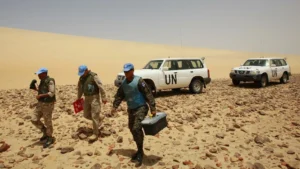
With neither resolution adopted, MINURSO’s mandate expired on October 31. On November 1, the mission entered a liquidation phase, involving the withdrawal of personnel, the closure of facilities and the repatriation or disposal of UN equipment.
Established in 1991, MINURSO was tasked with monitoring the ceasefire between Morocco and the independence movement Frente Polisario and preparing a referendum on the territory’s future. That referendum, originally envisaged for 1992, never took place, largely because of disagreements over voter eligibility and the terms of the political settlement.
The mission’s departure raises fundamental questions about the future of the conflict, the security of the territory and the prospects for the Sahrawi people’s long-standing demand for self-determination.
Definitions and descriptions matter greatly in this dispute. The United Nations classifies Western Sahara as a non-self-governing territory. Morocco refers to it as its “southern provinces” and considers it an integral part of its national territory. Algeria, which supports the Polisario Front and hosts Sahrawi refugee camps, maintains that the territory remains subject to decolonisation. The African Union, meanwhile, recognises the Sahrawi Arab Democratic Republic (SADR), the state proclaimed by the Polisario Front.
The competing positions reflect a conflict that remains unresolved both politically and legally.
On the ground, however, the balance of control strongly favours Morocco. Rabat administers approximately 80% of the territory, including its entire Atlantic coastline. The area under Polisario influence lies largely east of a fortified sand wall, known as the berm, constructed by Morocco to separate the two sides.
For more than three decades, MINURSO’s military observers and civilian personnel provided an international presence on both sides of the berm. Although the ceasefire largely collapsed in November 2020, following renewed hostilities, the mission continued to monitor developments and provide a channel for communication.
Its departure removes an important mechanism for international monitoring at a time when tensions remain elevated.
Morocco and Algeria have offered sharply contrasting assessments of the Security Council’s failure to renew the mission. For Rabat, the development represents a diplomatic victory and another opportunity to advance its position that Western Sahara should remain under Moroccan sovereignty, with autonomy for the territory’s population.
Algeria, by contrast, has expressed deep regret over the end of MINURSO, arguing that the Security Council’s failure to agree on a renewal undermines the prospects for a peaceful settlement and sidelines the Sahrawi people’s right to self-determination.
The Polisario Front has also criticised the outcome, maintaining that any political process must preserve the possibility of independence. Before the vote, it warned that it would withdraw from negotiations if the US proposal was adopted. The failure of both resolutions, however, leaves the movement facing a different dilemma: how to respond to the loss of the UN mission without further weakening its international position.
Legally, the end of MINURSO does not settle the sovereignty question or change Western Sahara’s international status. The United Nations has explicitly stated that the mission’s departure does not extinguish the Sahrawi people’s right to self-determination. The Secretary-General has also reaffirmed the UN’s commitment to supporting a negotiated political solution through his Personal Envoy, Staffan de Mistura.
Nevertheless, the absence of a peacekeeping presence could make an already fragile security environment more difficult to manage.
Beyond the rhetoric, there is little evidence that either Morocco or Algeria is eager to enter a direct military confrontation. Both countries have substantially increased their defence spending in recent years, but a regional conflict would carry considerable political, economic and security costs.
The greater immediate risk may be a gradual deterioration of the security situation, particularly if either side interprets the absence of international monitors as an opportunity to change the facts on the ground.
The real test will come if Morocco seeks to consolidate its control further or if the Polisario Front attempts to expand its military activities west of the berm. Neither scenario is inevitable, but the loss of MINURSO removes an important international presence that could previously monitor and report on developments.
Morocco also has a considerable economic advantage. Phosphate is central to its economic strategy, particularly through state-controlled phosphate and fertiliser producer OCP (Office Chérifien des Phosphates). Morocco possesses approximately 70% of the world’s known phosphate reserves, including deposits in Western Sahara.
The territory’s phosphate resources, particularly around Bou Craa, represent an additional economic asset for Rabat. Greater investment and production could strengthen Morocco’s economic stake in the territory, although the legal and international controversies surrounding the exploitation of Western Sahara’s natural resources remain unresolved.
OCP’s growing presence across Africa also gives Morocco an economic and diplomatic instrument through which to deepen its relationships with governments across the continent. Fertiliser is strategically important to African agricultural production, and Morocco has increasingly positioned itself as a major supplier and partner in the sector.
A second factor is Morocco’s growing diplomatic influence and its investment in infrastructure across the territory.
A number of African countries have opened consulates in Laayoune and Dakhla, a development Morocco regards as evidence of growing international support for its sovereignty claims. These diplomatic moves, however, do not constitute international recognition of Moroccan sovereignty by the United Nations.
Rabat has also embarked on an ambitious infrastructure programme centred on Dakhla, including the development of a major Atlantic port, road networks and other transport facilities. The projects form part of Morocco’s broader Atlantic Initiative, which seeks to improve access to Atlantic trade routes for landlocked Sahelian countries.
Mali, Burkina Faso, Niger and Chad have been identified as potential beneficiaries of the initiative. By offering these countries access to new trade and transport infrastructure, Morocco is seeking to strengthen its economic and political relationships with governments across the Sahel.
The strategic implications are considerable. As transport links and commercial networks become increasingly integrated into Morocco’s national infrastructure, the economic and logistical ties between Western Sahara and the rest of Morocco are likely to deepen. This creates a growing physical and economic reality that could make any future reversal of Moroccan control considerably more difficult.
Morocco’s overtures to the Economic Community of West African States (ECOWAS) should also be viewed within this broader strategy. Its objective is not simply to expand trade but to consolidate regional partnerships and strengthen support for its position on Western Sahara.
This is not to suggest that the Polisario Front and the SADR lack influential supporters. Algeria remains their principal political and strategic backer, while countries such as South Africa and Nigeria have historically supported the Sahrawi people’s right to self-determination. Other African states, including Angola and Ghana, have also maintained support for the SADR.
However, diplomatic support does not necessarily translate into a willingness to intervene militarily should the situation deteriorate.
On conventional military indicators, Algeria has considerable advantages over Morocco, including defence spending and military capabilities. But the political and economic costs of direct intervention could discourage Algiers from becoming militarily involved.
Relations between Morocco and Algeria have long been strained, with the two countries fighting a brief border war in 1963. Their diplomatic relations were severed in 2021, and their rivalry has since intensified.
Nevertheless, it remains unclear whether Algeria’s strong diplomatic language will translate into direct military action. Historically, Algiers has been reluctant to deploy its armed forces beyond its borders. A direct confrontation with Morocco would risk escalating a bilateral dispute into a wider regional crisis, with consequences for North African security and economic stability.
For its part, the Polisario Front is unlikely to match Morocco’s conventional military capabilities without substantial external support. This makes a sustained military campaign to reverse Morocco’s territorial gains a particularly difficult prospect.
The more immediate scenario, therefore, is likely to involve Morocco continuing to consolidate its administrative, economic and logistical presence, while the Polisario Front and its supporters seek to preserve international pressure for a negotiated settlement.
Perhaps the most conspicuous absence from this diplomatic and geopolitical equation is the Sahrawi population itself.
Moroccan media have reported expressions of satisfaction among local administrative authorities in Laayoune over the departure of MINURSO, while Algerian media have highlighted criticism from Polisario officials and supporters. Neither account provides a comprehensive picture of how ordinary Sahrawis view the latest developments.
The people whose future is being negotiated remain largely absent from the diplomatic calculations of the competing powers. Without independent access to communities on both sides of the berm, establishing their views and expectations remains difficult.
Ultimately, the end of MINURSO does not mean that the Western Sahara dispute has been resolved. Nor does it confer international legitimacy on Morocco’s sovereignty claims. What it does is remove an important instrument of international monitoring while leaving the underlying political disagreement unresolved.
For Morocco, this could create an opportunity to deepen its economic and administrative integration of the territory. For the Polisario Front and Algeria, it represents a setback in their efforts to keep the question of self-determination at the centre of international diplomacy.
Whether the outcome brings the parties closer to a negotiated settlement or further entrenches the divisions that have sustained the conflict for decades remains to be seen.
For investors and businesses considering opportunities in Western Sahara, the changing political and security environment also presents significant legal and operational risks. Africa Investigates can assist organisations with corporate intelligence, local source enquiries and due diligence to assess the risks associated with commercial engagements in the territory.