
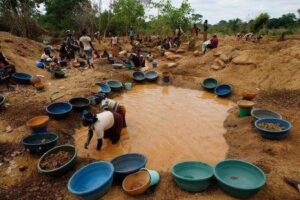
- Illegal gold extraction is a continent-wide problem, depriving African states of significant revenue while causing severe environmental damage and creating opportunities for criminal networks.
- Repression alone has repeatedly failed to eliminate illegal gold operations, as demonstrated by Côte d’Ivoire’s experience over the past decade.
- Local communities have economic stakes in illegal gold extraction, with the industry providing employment and income to workers, landowners, traditional leaders and other local stakeholders.
- The illegal gold trade operates across borders, relying on international networks for financing, equipment, transportation and the movement and sale of gold.
- A sustainable solution requires more than shutting down mining sites: governments need coordinated regional and international action alongside credible economic alternatives for communities dependent on the illegal gold economy.
The Ivorian government is the latest in a number of authorities to publicly declare their intention to put an end to illegal gold extraction, an industry that costs the state hundreds of millions of dollars in lost revenue, destroys the environment and attracts criminal networks.
The default response to these operations has centred on repression, overlooking the fact that, however harmful and short-term the benefits may be, communities stand to gain from their existence in a variety of ways.
Illegal gold extraction is also connected to international networks, making repressive measures taken at the national level largely ineffective.
A comprehensive package combining repression with incentives will be needed to reduce the number of illegal gold extraction operations. But this will require coordinated action at multiple levels — local, national, regional and international — which will be difficult to achieve.
The Government of Côte d’Ivoire announced in early September a series of measures, coordinated by the National Security Council (Conseil national de sécurité), intended to put an end to illegal gold extraction in the country, which has spread to virtually all of its 31 administrative regions.
The measures include mapping illegal sites, dismantling them, arresting and, if necessary, deporting individuals found working there, and preventing the operations from returning wherever possible. According to experts in the field, however, these measures are unlikely to work. Below, we explain why.
Côte d’Ivoire is among a long list of countries across the African continent — from South Africa to the Democratic Republic of the Congo, Cameroon, Uganda and South Sudan — where illegal gold extraction is a significant problem. The same is true in Côte d’Ivoire’s immediate neighbour, Ghana.
Estimates suggest that as much as one-third of the value of Africa’s gold output may be lost to clandestine extraction and smuggling, made more attractive by historically high gold prices on world markets.
The default reaction of authorities has been repression, and the measures announced by Côte d’Ivoire’s government fit the same pattern. They include identifying illegal sites with the objective of dismantling them and arresting the individuals found working there.
If necessary, workers can be deported, since many people working at these sites come from outside the country — another pattern repeated across the continent, such as Mozambicans working on gold extraction sites in South Africa. Other measures include establishing a sanctions regime targeting those who provide financing and materials to the illegal operations.
Experts point out that these constitute not only a familiar set of measures but also that they have repeatedly failed to resolve the problem.
One historical example is Côte d’Ivoire itself. Illegal gold extraction expanded in the aftermath of the 2010 political crisis and was subsequently repressed by the authorities between 2014 and 2016, only to return in even greater numbers a year later and persist until today.
One figure illustrates the scale of the challenge. According to figures supplied by Ivorian law enforcement authorities, 8,500 illegal gold extraction sites have been dismantled since 2021, while 4,500 people found working at those sites have been arrested and, where necessary, deported.
These figures strongly suggest that the majority of workers at clandestine sites do not face arrest. This makes sense, particularly when one considers that illegal gold extraction operations are not isolated from their surroundings but form an integral part of a vast and expanding local economy.
Workers may therefore receive advance warnings of approaching law enforcement operations, giving them time to escape.
Given the paucity of legitimate employment opportunities, particularly for young and under-educated men who make up much of the on-site workforce, communities can benefit from illegal gold extraction in a variety of ways.
It provides young men with employment opportunities, despite the extremely poor working conditions and insecurity surrounding the sites. It also gives some of them wealth and status.
Furthermore, communities — often small villages and towns — may see their young men employed rather than unemployed, idle or engaged in petty crime. From this perspective, the activity can represent a net gain for communities. Even when these young men are at the bottom of the illegal gold extraction hierarchy and earn only a fraction of what organisers, financiers and supervisors make, they are still earning an income in circumstances where they may otherwise have none.
Everyone has a stake in these operations, making them difficult to contain or roll back.
The owner of the land where extraction takes place gets a share, as do traditional leaders who permit the activity to continue under their authority. Complicity by local law enforcement, administrators and politicians may also bring financial rewards.
Those who lose land and livelihoods as a result of the activity, as well as those affected by the widespread pollution associated with illegal gold extraction, bear the costs. Yet they may find it difficult, if not impossible, to defend their interests.
Another important aspect is that illegal gold extraction operations are not only part of a local economy that benefits communities and other stakeholders; they are also embedded in networks that cross national borders.
These are large-scale operations requiring a range of inputs. First, they require financing to pay for on-site tools and other materials, including the highly polluting and dangerous cyanide and mercury used to extract and process gold.
Second, they require transportation to bring in the necessary materials and move the gold out of the country towards its eventual destination, including major international trading hubs such as Dubai.
Dismantling sites and apprehending the mostly young men working there therefore addresses the problem at the wrong end of the chain. It does little to disrupt the sources of financing, logistics and international networks that lie beyond the reach of national authorities.
The profits available from illegal gold extraction also attract drug use and prostitution. Recent United Nations reports have pointed to the involvement of individuals and networks controlling these operations in forced labour, sexual exploitation, human trafficking and drug smuggling.
Illicit financial flows associated with these operations can also fuel armed insurgencies and terrorism.
Islamic State-affiliated groups operating in countries including Niger and Burkina Faso have been reported to derive income from artisanal gold mining sites they control. The Russian mercenary organisation Wagner and its successor, Africa Corps, have also been reported to use transport networks to move gold out of Mali, Sudan, the Central African Republic and elsewhere on the continent where they operate.
In Côte d’Ivoire, opposition media and politicians have also repeatedly alleged that a major unregistered open-air gold mine was under the control of Issiaka Ouattara, nicknamed “Watao”, a former rebel commander in the north of the country during the 2002–2011 conflict.
There is also information suggesting that the jihadist group JNIM (Jama’at Nusrat al-Islam wal-Muslimin), which operates primarily in Mali, Burkina Faso and Niger and poses a threat to neighbouring countries, derives at least some income from its involvement in networks connected to illegal gold extraction in Côte d’Ivoire.
This makes the issue not only an environmental and economic concern but also a national security issue.
Illegal gold extraction that fuels terrorism, insurgencies or rebel movements is one pressing reason to combat the problem. The immense environmental damage it causes and the loss of legitimate livelihoods for people living near these operations are others.
There are reports that villagers in various parts of Côte d’Ivoire have attempted to stop illegal gold extraction operations, putting them on a potentially violent collision course with the diverse groups protecting the sites. These may include demobilised rebel fighters and/or soldiers, traditional hunters, private security companies, renegade members of law enforcement and others. Some of these groups may overlap.
Combating illegal gold extraction therefore demands more than repressive measures at the national level.
It requires coordinated action at regional and international levels, as well as governments — acting independently or within international frameworks — developing alternatives that are less harmful.
Arguably most importantly, however, governments must recognise that communities currently benefit from these operations. As long as the short-term economic gains from clandestine gold extraction remain more attractive than legitimate alternatives, efforts to eliminate the activity are likely to face resistance.
The challenge, therefore, is not simply to shut down illegal gold operations. It is to create economic alternatives that communities consider sufficiently viable to make leaving the clandestine gold economy a realistic choice.