
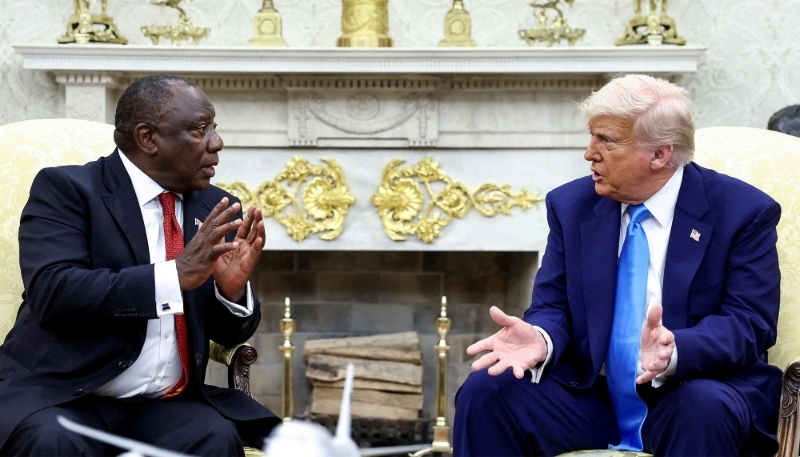
On 26 March, French officials denied reports that they had disinvited South Africa to the upcoming G7 summit in June. They added that Kenya would be invited instead to participate in international finance reform discussions.
- Amid rising global geopolitical polarisation, Kenya and South Africa will face mounting pressures to align with the US and its partners.
- Withstanding these pressures will be difficult, especially for Kenya, which continues to rely on Western aid and security cooperation.
- Kenya will occasionally benefit from diplomatic spats between South Africa and the US, but the latter country is unlikely to completely sideline South Africa.
- Moreover, in the longer-term, it will become increasingly difficult for Kenya, for whom China is an important trade partner and creditor, to appease the US.
US pressures?
The G7 brings together France, the US, the UK, Italy, Japan, and Germany. The platform often invites non-members to its meetings and summits, and South Africa is a regular attendee. However, Vincent Magwenya, the spokesperson for South African President Cyril Ramaphosa, said on 26 March that France had informed him that South Africa is not invited this year. Magwenya said that South Africa respects the decision of France and suggested that it results from US pressures. Although French officials denied any US involvement in the decision, recent tensions between the US and South Africa have fuelled rumours that the US threatened to boycott the G7 summit if South Africa is invited. This is especially because US President Donald Trump boycotted the G20 summit hosted by South Africa in November 2025. Moreover, on 26 November 2025, Trump said that the US would not invite South Africa to the 2026 G20 (hosted by the US), even though South Africa is a member of the G20.
In addition to the summit, Kenyan President William Ruto is expected to participate in preceding discussions regarding reforms to the international financial system. These are intended to address the development divergence between high-income countries and the developing world. Kenya will also host the France-Africa summit in May.
Geopolitical polarisation
As global geopolitical competition worsens, so will the rivalry between South Africa and Kenya. Both countries have successfully positioned themselves as diplomatic hubs in their respective regions and are seen as crucial to the implementation of a wide range of international interests in Eastern and Southern Africa. However, their ability to withstand the pressures to align with one global power over another is widely different. Western partners, especially the US and France, will be keen to capitalise on this in the coming year.
Kenya’s relations with the West are underpinned by aid and security cooperation, whereas for South Africa, trade forms the basis of most engagements with the West. This does not necessarily mean that the West is less important to South Africa. Indeed, the US is an important export market for South Africa’s automotive industry. Rather, this difference means that although South Africa will remain keen to preserve cordial relations with the US, it will increasingly seek out alternative trade partnersSouth Africa has a strong network of bilateral partners and a relatively developed business environment. For example, uncertainties regarding the African Growth and Opportunity Act (AGOA), which grants African markets duty-free access to US markets and the imposition of tariffs on South African imports hampered the automotive sector in 2025. Despite this, South African manufacturers were able to obtain alternative export partners.
On the other hand, for Kenya, replacing Western aid and security cooperation would be an uphill task, especially as persistent global economic uncertainties reduce the availability of foreign aid. Because of this, it will be much harder for the Kenyan government to resist Western pressures, even as the country seeks to preserve the status quo with China. Moreover, unlike Kenya, which lacks strong institutional political parties, South Africa’s ruling party, the African National Congress (ANC), has strong political ideologies that will inform its stance on global matters, occasionally pitting South Africa against the US. For instance, the ANC’s strong opposition to apartheid will sustain South Africa’s strong stance against Israel, a close ally of the US). Moreover, given the historical ties between the ANC and Russia’s United Russia Party (URP), the US will remain wary of South Africa’s relations with Russia.
South Africa to retain dominance
Kenya will be keen to demonstrate its diplomatic alignment with the US regarding these matters. Ruto, who is keen to expand Kenya’s geopolitical influence beyond East Africa, will take advantage of these tensions to position Kenya as a gateway for Africa. Although this will strengthen security cooperation between Kenya and the West, Kenya is unlikely to erode South Africa’s influence in Africa, at least not in the coming years. First, Kenya has faced mounting allegations of interference in domestic conflicts, for instance, in Sudan. This is likely to expose Ruto to some level of suspicion from other countries, even within the East African Community, complicating his ability to position himself as Africa’s representative.
South Africa has a strong economic and political influence in Africa, especially in the Southern African Development Community (SADC) region. South Africa also continues to enjoy the respect of many African countries due to its role in mediating many conflicts. Because of this, sidelining South Africa in favour of Kenya could be detrimental to Western interests in the long run, especially as this would facilitate engagements with rivals of the US, such as China and Russia. In our view, the decision to uninvite South Africa to the G7 is intended to push South Africa to soften its position regarding key US diplomatic agendas, including the war between Israel and Hamas. We expect engagements between South Africa and the US to continue despite periodic diplomatic spats. South Africa is also likely to engage in intense lobbying to woo the Trump administration. In the meantime, South African exporters to the US will remain vulnerable to periodic disruption and uncertainty.
Tough times ahead for Kenya
Meanwhile, for Kenya, diplomatic alignment with the US will become increasingly important, especially given the increasingly transactional nature of US foreign policy for Africa. However, Kenya will struggle to balance this with the need to appease China, its largest creditor and trade partner. As the desire of the US to erode Chinese influence in Africa intensifies, it will become increasingly difficult for Kenya to appease both parties. In the meantime, Kenya will continue to leverage its strategic role in the US counterterrorism agenda to manage any fall-outs.
South Africa and Kenya will both seek to increase their regional influence to boost their bargaining power with the West. Both countries will seek to maximise their influence over conflict resolution and economic reforms in the DRC, which is key to the US critical mineral agenda. The balance of power is in South Africa’s favour because of the animosity between Ruto and President Felix Tshisekedi. Moreover, South African firms have a strong economic influence in the DRC’s mining and infrastructure sectors, and are better placed to benefit from the increased US investor interest in the DRC. In our view, Ruto will seek to mend his relations with the DRC over the coming years. These dynamics could cause sporadic spats between Kenya and South Africa, but they will both seek to retain cordial relations.
Sources
Ramaphosa’s G7 exclusion and Ruto’s rising star amid US, SA row, The East African
France denies excluding South Africa from G7 summit under pressure from Washington, Reuters
For tailored analysis on geopolitical tensions in Africa, please contact Africa Investigates Incorporated.
Email: africainvestigates2020@gmail.com
Tel: +221785282247