
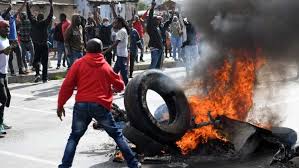
 On 7 June, South African President Cyril Ramaphosa warned against incitement to violence, amid rising anti-immigrant unrest in the country.
- As grievances over high unemployment rates and poor public services persist, xenophobic sentiments against African immigrants in South Africa will persist in the coming years.
- Politicians are likely to exploit these sentiments ahead of the 4 November local elections, boosting the position of xenophobic vigilante groups.
- Nonetheless, given the country’s relatively robust human rights protection mechanisms and anti-hate speech laws, we do not expect influential politicians to openly endorse xenophobic groups.
- Despite this, unrest targeting African immigrants will persist, and could escalate into one-off incidents of widespread violence in low-income areas.
- These dynamics will elicit serious concerns from other African countries, but this is unlikely to lead to a major diplomatic backlash against South Africa, at least in the short term.
Xenophobic sentiments
Ramaphosa said that the authorities will intensify the enforcement of immigration laws, including the deportation of undocumented immigrants. He nonetheless insisted that illegal immigration is not the main cause of socio-economic issues in the country, and warned that the authorities would take action against the perpetrators of mob justice against immigrants. This comes amid rising concerns over growing reports of violence against African immigrants in South Africa in recent months.
The March March movement, a local anti-immigration vigilante group, has organised a series of protests in Durban, Pretoria, and Johannesburg since April. According to Human Rights Watch, these protests have in some instances escalated into violent attacks targeting African and, to a lesser extent, Asian immigrants and their businesses. Human Rights Watch also claims that the security forces have not responded sufficiently to such incidents.
Meanwhile, the government of neighbouring Mozambique on 1 June announced that five Mozambican citizens were killed in “xenophobic attacks” during an anti-immigration protest in Mossel Bay the weekend prior. Moreover, Ghana said on 6 May that it had launched a voluntary repatriation scheme for its citizens in South Africa, and urged the African Union to address the matter. Several other African countries, including Kenya, Malawi, and Zimbabwe, have issued warning advisories to their citizens residing in South Africa.
Despite Ramaphosa’s warning, rights groups fear that the violence will escalate as 30 June, the deadline that the March March movement gave for all undocumented immigrants in the country to leave, approaches.
Political, macro-economic considerations
We do not expect the rising anti-immigrant sentiments among segments of the South African population to expose the South African government to major diplomatic backlash. Concerns that these sentiments could easily escalate into xenophobic violence and human rights abuses are genuine, especially given the rise of online misinformation on the continent. In addition, despite Ramaphosa’s strong statement, some South African politicians, including those from his African National Congress (ANC), will tap into xenophobic sentiments to woo disenfranchised communities ahead of the 4 November local elections. Corruption scandals, which were especially widespread under former President Jacob Zuma (2009-2018), have hampered the ANC’s public image, forcing sections of the party to resort to populism to appeal to the population. At the same time, broader institutional issues, including socio-economic inequalities resulting from the apartheid era, and rising fiscal pressures have made it difficult for South Africa to address its unemployment crisis.
To downplay the impact of these issues on the quality of government services and the lack of economic prospects for young people, politicians will increasingly highlight the large presence of immigrants in the country. However, South Africa has relatively robust human rights protection mechanisms, which include strict restrictions on incitement to violence. This will discourage most politicians from openly endorsing xenophobic rhetoric and vigilante groups such as the March March movement. Nonetheless, the growing focus on immigrants in political discourse risks driving more inflammatory rhetoric against immigrants, strengthening the position of vigilante groups. In low-income areas, where the security forces are already struggling to contain gang activity, anti-immigrant protests are increasingly likely to escalate into large-scale incidents of violence, especially as they facilitate opportunistic looting. Such incidents could occasionally expose foreign immigrants to serious violence, including death. Widespread incidents of xenophobic violence cannot be ruled out in the next few weeks. Nonetheless, most incidents of this kind will be brief.
Outlook
African countries will intensify pressure on South Africa to dismantle xenophobic vigilante networks. Although this may cause occasional diplomatic spats, the impact on trade and diplomatic cooperation will be minimal. South Africa will engage in extensive lobbying in the coming months to highlight the role of its democratic institutions in protecting immigrants from major human rights abuses. The country will also leverage its extensive influence in the SADC region to suppress scrutiny in the AU. In the long-term, however, South Africa’s growing reputation for xenophobia against Africans will threaten its already fragile position as a regional leader.
Meanwhile, to assuage local youths, the authorities are likely to tighten the enforcement of the country’s rigid labour and local content regulations, including diversity quotas for black South Africans, women, and disabled people. In addition to increasing compliance costs, this will expose operators to major regulatory uncertainties because petitions seeking to challenge some of these regulations are still pending.
Sources
“South Africa’s President Ramaphosa moves to diffuse anti-immigrant tensions in TV address” Africanews
“African countries warn citizens of xenophobic attacks in South Africa” Reuters
For tailored analysis on the geopolitical implications of xenophobia in South Africa, please contact Africa Investigates Incorporated.
Email: africainvestigates2020@gmail.com
Tel: +221785282247